
By Catherine Quinn
Ready to write your organization’s first strategic plan? It can be a daunting endeavor – after all, this document is going to be your organization’s guiding light for the next five years. No pressure, right? Thankfully, while writing a strategic plan is never easy, it doesn’t have to be complicated. The process can be as simple as three steps: data gathering, analysis, and drafting.
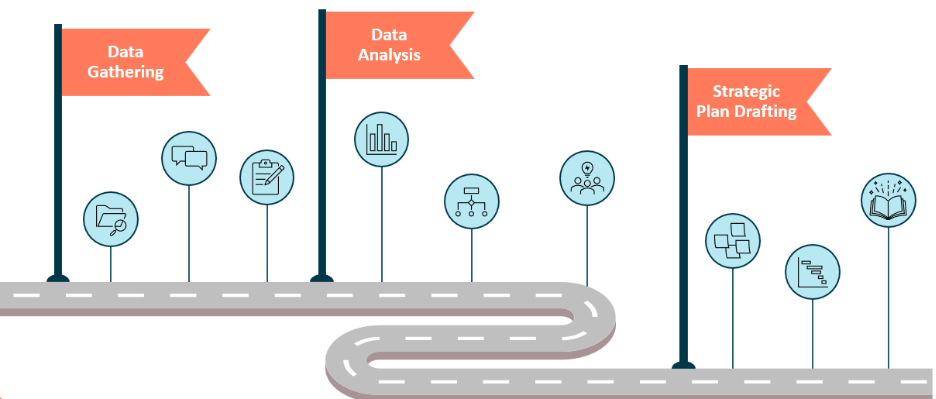
The data gathering stage builds the foundation of your plan, rooting it in fact, not feeling. This should include data about your organization today and the broader competitive landscape. Consider what data would inform the components of a Business Model Canvas and a Porter’s Five Forces model. Whenever available, collect quantitative data in these areas. To color the quantitative findings with nuance, interview key leaders across the organization. Interview questions should cover overall strategic direction (e.g., “What do you want your organization to achieve in 10 years?”), the business model (e.g., “What does the ideal client look like?”), and competitors (e.g., “How does your organization differentiate from competitors?”).
Once you have gathered all the data, it’s time to analyze it. While the volume of data – and differences of opinion in interview findings – may be overwhelming, the Business Model Canvas, Porter’s Five Forces Model, and a variety of facilitation techniques can drive conversation among the leadership team around where the organization is today and where it wants to go. The desired future state becomes the strategic vision. With the starting and end points agreed upon, the next step is a gap analysis: How does the organization get from point A to point B? That ‘how’ – likely a number of actions – becomes the meat of the strategic plan.
The last step is drafting. The gap analysis findings will likely fall into discrete groups, such as people, process, and technology. These groups become goals, with objectives and tactics under each. Once the content is organized, leaders must add in success metrics, owners responsible for execution, and relative priority. And voila! A draft plan. After a technical edit, a graphic designer can develop a visually engaging final product.
All told, the strategic planning process is never quick or easy – and it’s worthwhile to take the time to get it right. But, when approached methodologically, the process becomes very manageable.